The State of Product Development in 2026 — and Where AI Is Taking the Industry
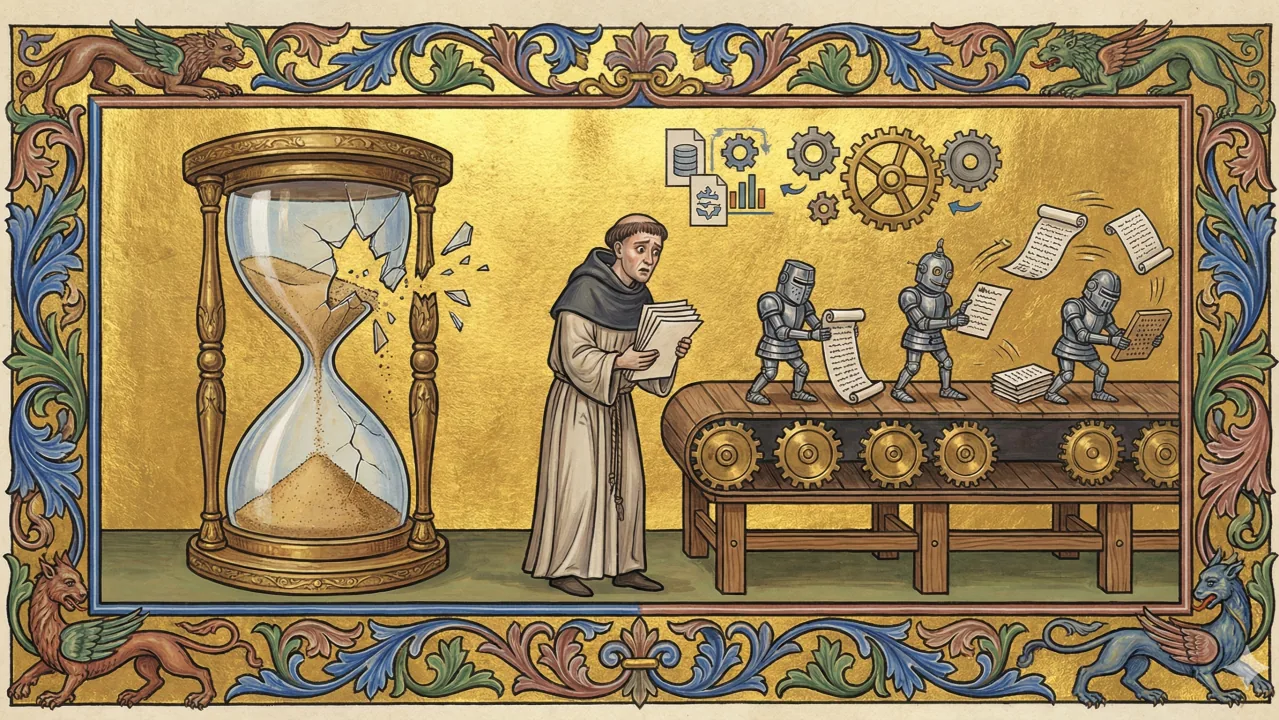
For those lost in Product Management: How AI changed the industry and where we are now.
(Briefly about me: I’ve been building digital products for 20 years, I manage the Mitgo.VC venture fund, and I also have experience building a $30M corporate startup studio).
With the release of ChatGPT, the industry of digital product creation and Product Management began to change drastically. For a long time, it was unclear what was happening. Old frameworks and approaches were no longer relevant.New ones hadn't been invented yet. Everyone was busy testing: "What can AI do? Can it do this? What about that?"
We knew we had to learn, but what and from whom was unclear. Any course related to AI became obsolete by the time you finished it.
I had the exact same confusion. I can be a bit slow on the uptake, it took me two years to get my bearings. But the picture finally came together. I now see what works, what to hope for, what to expect, how development teams will change, and which professions and roles will be in high demand.
Disclaimer: This post is for practitioners implementing AI in corporations and startup founders, not for scientists working on cutting-edge AI models.
So, what has AI (LLM) done to the digital product industry, and where is the bottleneck now?
Part 1. AI for Mere Mortals (Not Elon Musk)
First off, it seems we’ve already survived the most powerful leaps and shocks. When ChatGPT didn't exist and then suddenly appeared—that was "Wow." The transition from version 4.1 to 5.2 makes GPT stronger, but it doesn't change the game. Until they build new data centers and the power generation systems to run them, we should expect smooth, gradual changes.
It’s the perfect time to look around: What is AI (LLM) and what has it given us?
Key point: It has equalized access to the advanced knowledge of humanity. In principle, you could find out what humanity knows about X via Google before, but now it is 10 times faster and cheaper.
You, just like your neighbor, are 2 seconds away from answers to questions that already have information available on the internet. All existing best practices are available to you for free.
You have to remember that LLMs are only as good as their datasets (the data they were trained on). In a situation where everyone is equal (armed identically), the product advantage comes from finding information that is not yet in the databases.
No LLM will tell you exactly which features (specifically in your market, in your niche) your customers will like. Unless you aren't making a new product, but simply repeating what has already been documented (and we all know what kind of documentation PMs leave behind, so don't get your hopes up).
Conclusion: Proportionally, a large part of your company should be engaged in mining information currently unavailable to LLMs. Real R&D activity: gathering new data, digitizing it correctly, and storing it. For everything else, there are AI agents.
There is a growing demand for people with ideas (good taste and visual experience). AI won't invent the new; it will suggest what likely needs to be done based on the past. And looking at entrepreneur communities, it is clear that AI has not solved the task of creating new ideas at all.
Overall, humans have taken a step toward being more rational creatures. You now have a tool to try and calculate any decision or at least get a second opinion. Which is good.
Part 2. The Backlogs Have Moved
Previously, being a Product Manager (I’m talking about the role, no matter what you were called—Founder, CEO, CTO, Marketer… someone performs the role of "what exactly are we going to develop") was fairly simple.
You worked, generated an interesting roadmap of features, and then you could more or less relax, knowing that development would take a year or two to process it.
Now, thanks to Cursor and similar tools, those same backlogs (which at large companies were measured in years) have shrunk significantly. And for the first time, management has found itself in a situation where development will soon have nothing to do.
This has spawned new risks:
Clutter: People start throwing "whatever" into the backlog just to keep the coders busy. Technical Debt: We write code faster than we have time to think about architecture. The speed of coding has exceeded the speed of comprehension. We release features faster than marketing can talk about them, and faster than analysts can understand if they worked or not.
Part 3. A New Model of Thinking: Cut, Then Measure
The root mental model in business has changed. The old principle "Measure twice, cut once" was relevant when resources were limited and mistakes were fatal (like ruining expensive fabric). Today, the winning strategy looks different: "Cut, measure, iterate."
Why does this work now? Previously, product development was long and expensive, so the lion's share of time went into planning. Now, speed is more important than sterility.
Fast Launch: If we aren't talking about a massive infrastructure project, but something local—which landing page to choose? What if we add a button here? The idea goes straight to work (no long discussions, prioritizations, to do or not to do). Instant Feedback: We carefully track what the decision influenced. The Right to be Wrong: If the hypothesis isn't confirmed, we roll back and try another path.
In total, this iterative approach allows you to move times faster than competitors stuck in battles between meanings and top management opinions. No one knows what will work. And if previously the HIPPO (Highest Paid Person's Opinion) determined what went into work, now you can verify it immediately and understand the facts.
Important Clarification: There are 2 types of decisions. If a decision cannot be quickly "rolled back" (e.g., in medicine or when working with people), we return to the classic "measure twice." But where the cost of a mistake is just development time, it is cheaper to implement two ideas immediately and find out the truth than to discuss and choose one.
To summarize, how to adapt product teams for AI:
More resources for Discovery stages. Allocate more time for fleshing out tasks. You want your backlog to be 2-4 times longer and more detailed than it was 5 years ago. More resources for Analytics. There is a growing demand for measurement: what did the decision influence? Digitizing data along the way, analyzing reasons for success/failure, and replenishing the backlog with new tasks. "Hold" on development resources. In fact, more departments can be included in sprints, rather than being turned away at the door with the phrase "requests from your department will never make it into the roadmap."

Part 4. The MVP Crisis and the Renaissance of Quality
There is harmony in the world. When everyone built expensive things (long plans, 2-3 year development cycles), power belonged to those who could build fast. That’s how Agile and Lean Startup appeared. Now, when an MVP can be made in a week, value has shifted back to those who can provide Quality.
Yes, tests and validation of ideas haven't gone anywhere. But a "barely working" MVP won't get you anywhere today. Rather, it will give you false data that causes you to take a wrong turn.
The AppStore and other platforms are clogged with AI Slop (garbage content); a sea of solo founders have released their mini-products. And it is still unclear where they will get customers. So, if against the background of 10 quick knock-offs, you have a normal, finished product with high-quality content and marketing support, you will have at least some chance of being noticed.
And most importantly: AI is terrible at UI/UX. All 99 products you make, it will shove into the 5-6 templates it knows. This is excellent, as it gives you the opportunity to distinguish yourself from the generated AI apps.
How will the Product Manager's work change? In classical theory, the PM role was responsible for:
Monitoring the market and reacting. Keeping the roadmap current. Running experiments and tracking efficiency. Audience research (CustDev, surveys). Gathering new ideas for the backlog. Working with stakeholders (from designers to the CEO). Often product marketing and analytics too.
In practice, doing all this well was impossible for one person. Now, if you surround yourself with AI agents, you can accomplish much more. All these tasks are still relevant. There are plenty of experiments where people lived on a backlog generated by AI — with little good to show for it. AI hasn't changed anything here, only the toolkit of how to do it, not what to do.
Summary: Which Way is the Wind Blowing?
What needs to increase (automatically reducing resources for everything else):
Demand for volumes of new, high-quality content. We aren't talking about AI slop, but data that isn't in AI yet. After all, there is now someone to process and read it all. We need the digitization of knowledge that was previously stored only in people's heads. Data collection is a religion. Whatever you do, you must collect and properly store data in the process (what the product generates, client feedback, hypothesis results). Otherwise, your AI agents won't get smarter, and that is a bad idea in the long run. General LLMs will be plus or minus the same for everyone; the difference will be in corporate models with access to unique data. Expansion of functionality. In every profession, there have always been 10-20 things that "would be nice to do, but we never get around to." Now you finally have the opportunity to do them. Focus on ideas. Spend more time on research and generating the backlog. Before, there was no point if tasks were already pending for 3 years. Now: either we reduce production, or we need more ideas and resources to analyze what has been done.
The most important part of the PM role today is the binary evaluation of the result: Did it work or not?
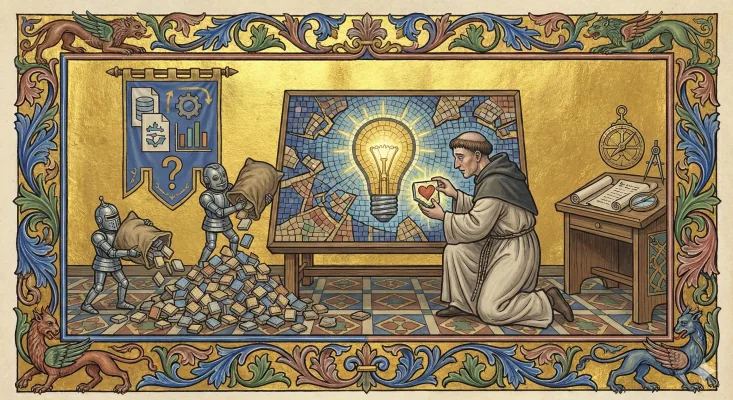
You might have 45 AI agents that brilliantly performed 45 small tasks. But simply stitching 45 perfect body parts together doesn't create a human—it creates Frankenstein's monster. Do these pieces of code and design add up to a living, breathing business? Did the pieces form a whole? For now, only a human can answer this question.
Total: The building blocks and tasks haven't changed much, but the distribution of resources needs a noticeable adjustment. And then we can calmly and successfully await the next wave, which will wash away the current scheme all over again.
That's life. :)